High Speed Label Printer for PVC and Wood Materials

Title: Revolutionize Your Production: The Game-Changing Power of Single Pass UV Printers
Subtitle: Why waiting for prints is costing you money—and how to eliminate the bottleneck forever.
In the fast-paced world of industrial printing, speed is not a luxury; it is a survival tactic. If you are still relying on multi-pass or scanning UV printers, you know the frustration: slow output, banding issues, and a bottleneck that clogs your entire production line.
Enter the Single Pass UV Printer—the technology that is rewriting the rules of high-speed, high-quality printing.
What is a Single Pass UV Printer?
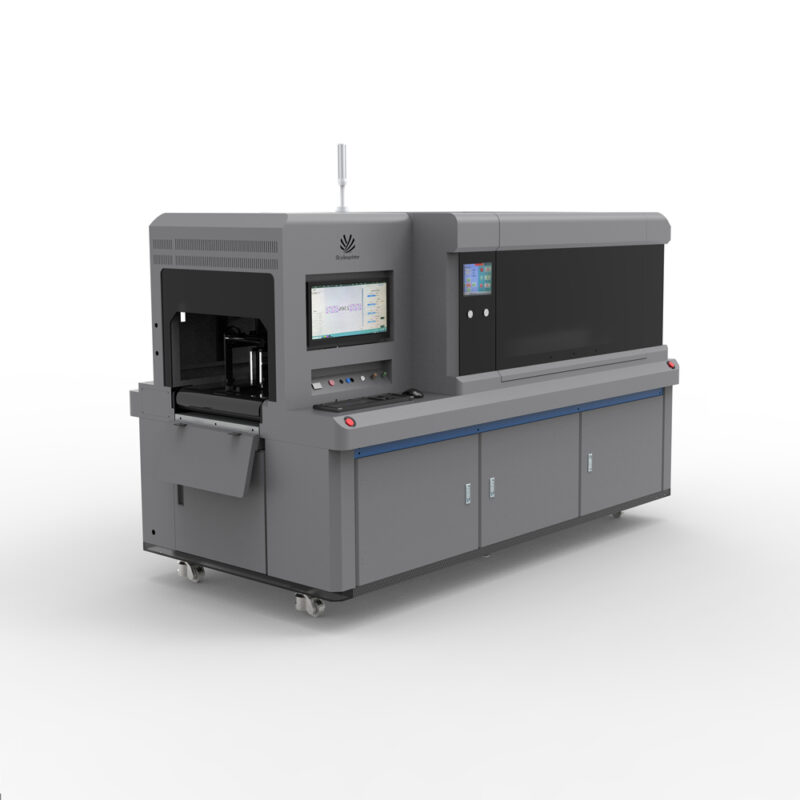
Unlike traditional printers where the print head scans back and forth across the material, a single pass printer uses a fixed array of print heads that span the entire width of the substrate. The material glides under the heads once, and the image is complete instantly.
Think of it as the difference between painting a fence with a single brush (multi-pass) versus rolling the entire fence under a pre-inked stamp in one second.
The Unfair Advantages You Get
- Speed That Changes Your ROI
We aren’t talking about incremental gains. Single pass technology delivers print speeds of 50 to 80 meters per minute—or even higher. Jobs that used to take an hour are finished in seconds. This allows you to take on massive volume contracts (labels, corrugated boxes, commercial mail) that were previously impossible to bid on. - The End of Banding
Because there is no back-and-forth motion, there are no “pass lines.” Every single pass printer delivers flawless, smooth gradients and solid colors. Your customers will stop asking, “What are those lines?” and start asking, “How did you get it so perfect?” - Instant Curing, Instant Shipping
UV inks dry the nanosecond they hit the UV lamps. No drying racks. No smudging. No waiting. You print directly onto virtually any rigid or flexible material—from corrugated cardboard and PVC foam to glass, metal, and wood—and it is ready for finishing or shipping immediately. - Lower Labor, Lower Waste
With a multi-pass printer, an operator spends their day watching a carriage move. With single pass, the operator becomes a logistics manager. Automation reduces human error, ink waste, and substrate waste. Your cost per part drops dramatically.
Who Needs a Single Pass UV Printer?
· Packaging Converters: Print variable data or full-color graphics on corrugated boxes at the speed of your production line.
· Label Printers: Produce shrink sleeves, wine labels, or industrial tags without stopping.
· Industrial Manufacturers: Print directly on flooring, sports equipment, or electronic components.
· High-Volume Signage Shops: Produce retail displays and banners faster than a screen press, but with digital flexibility.
The Myth of “Too Expensive”
Yes, the initial investment for a single pass UV printer is higher than a desktop or roll-fed model. However, calculate your cost per hour of production. Calculate your labor costs. Calculate the revenue from jobs you currently turn away because you can’t meet the deadline.
Most customers recoup their investment in 6 to 18 months. After that, the printer becomes a pure profit engine.
Don’t Get Left Behind
Your competitors are already looking at this technology. While they are waiting for their multi-pass printer to finish the fourth pass, you could be packing the order.
It’s time to stop printing. It’s time to start producing.
[Contact us today] for a live throughput analysis. Tell us your average monthly volume, and we will show you, in black and white, how many hours you will save next week—not next year.
Single pass, zero compromises, infinite possibilities.